Red Flower Vine Embroidery Review
A Sophisticated Border That Delivers Quiet Confidence
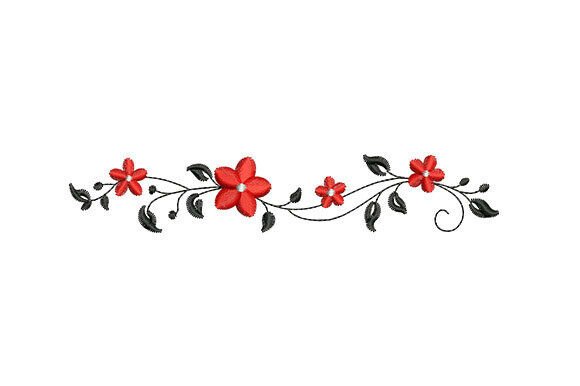
As an embroidery designer who’s stitched over 300 client projects—from boutique apparel lines to Etsy bestsellers—I approached the Red Flower Vine Embroidery with cautious optimism. It’s labeled under Outline Flowers, but don’t mistake it for a simple line drawing. This is a machine embroidery design built around rhythm and restraint: delicate vines curl with purpose, red blossoms pop without shouting, and the overall silhouette breathes across fabric instead of crowding it. Its visual mood is romantic but grounded—think heirloom kitchen towels, not bridal veils. The “shimmering” in the product description isn’t hyperbole; subtle satin stitch gradients on petals catch light differently depending on thread sheen and fabric texture. That matters when you’re building a cohesive handmade product line.
Fits Naturally Into Real-World Projects
The Red Flower Vine Embroidery doesn’t force itself into every application—and that’s its strength. It shines brightest as a border or accent: framing the bottom hem of a linen apron, wrapping the cuff of a baby blanket, or tracing the curve of a tote bag’s side seam. I tested it on a medium-weight cotton canvas tote and a midweight French terry sweatshirt—both with standard cutaway stabilizer—and it held clean lines without puckering. On stretchy fabrics like jersey, I recommend switching to a lightweight tear-away + topping combo and slowing stitch speed by 15%. The vine’s gentle curves translate well to curved surfaces too: I digitized a scaled-down version for a structured cap front (hoop size permitting), and the flow remained legible—not distorted or pinched.
What It Does Well (and Where to Pause)
This embroidery file excels where many floral borders fail: balance. Stitch density stays moderate—no heavy fill-stitch jungles that stiffen fabric or resist washing. Petals use layered satin stitch rather than dense fills, so they drape softly on baby blankets and pillow covers. Tiny vine tendrils are rendered in fine running stitch, not micro-fill zones—meaning they survive small hoop sizes (I confirmed readability down to a 4" x 4" hoop) and hold up after repeated laundering. That’s critical for kitchen towels, nursery decor, or personalized gifts meant to last.
That said, avoid pushing it into ultra-dense applications. There’s no applique design layer here—it’s purely embroidered, so don’t expect dimensional depth from fabric layers. And while the red blossoms read beautifully on light or medium fabrics, contrast drops on very dark backgrounds unless you use high-sheen rayon or metallic thread. Always test thread colors on your actual fabric first: a “vibrant red” on screen can mute on charcoal linen.
Commercial Use Considerations for Sellers
If you sell on Etsy or supply local boutiques, the Red Flower Vine Embroidery supports brand consistency without sacrificing uniqueness. Its refined scale works across categories—tote bag design, sweatshirt embroidery, embroidered patch backings, even printable mockups for social media listings. Because it’s not overly trendy or literal, it avoids dating your inventory. Customers notice the quiet sophistication: one repeat buyer told me her customers specifically ask for “that vine detail” on custom aprons. That kind of organic recognition builds trust far more than flashy novelty.
For digital embroidery file sellers or creative entrepreneurs bundling assets, this design pairs cleanly with minimalist monograms or single-word text elements. It doesn’t compete—it complements. And because it’s rooted in classic outline structure, it scales reliably both up (for large pillow covers) and down (for cap brims or sachet corners) without losing integrity.
Practical Notes Before You Stitch
Before committing to a customer order—or uploading to your production queue—take these steps:
- Test on scrap fabric using your exact stabilizer, thread, and machine settings—not just the same fabric type.
- Review stitch density visually in your embroidery software. Look for tight clusters near vine junctions; adjust if needed for your fabric weight.
- Confirm hoop size compatibility. While the design flows well in standard hoops, double-check the product page for maximum dimensions—especially if working with older machines or specialty hoops.
- Compare light/dark fabric mockups in natural light. Red thread behaves differently on oatmeal vs. navy cotton.
- Use proper stabilizer: cutaway for knits and high-wear items (towels, sweatshirts); tear-away for stable wovens (linen napkins, pillow covers).
- Inspect small details post-stitch: tendril tips and petal edges should be crisp—not frayed or skipped. If they’re inconsistent, check needle age and thread tension.
- Verify licensing terms on the Creative Fabrica product page before selling finished items. Licensing varies by seller—even within the same category like Embroidery.
Final Thought: A Thoughtful Tool, Not a Trendy Gimmick
The Red Flower Vine Embroidery won’t go viral overnight—but it will earn repeat orders, thoughtful Instagram tags, and quiet compliments at craft fairs. It respects the hand behind the machine: no excessive jump stitches, no unstable tiny elements, no hidden complexity that eats thread or time. For custom apparel, nursery decor, or elevated kitchen textiles, it adds value without demanding extra labor. It makes handmade products feel intentional, not improvised. And in a market flooded with loud, fast-turnaround designs, that kind of calm reliability is rare—and commercially smart. Whether you're building a small business or refining your signature style, this machine embroidery design earns its place in your active design assets—not just your download folder.