Minimalist Line Art Machine Embroidery
A Designer’s First Look: Clean, Confident, and Quietly Professional
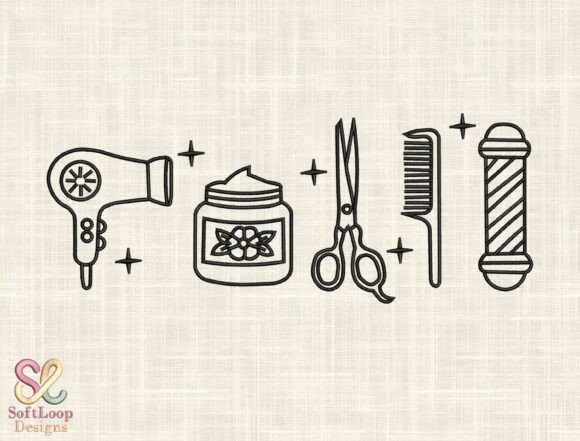
When I opened the Minimalist Line Art Machine Embroidery file for the first time, what struck me wasn’t flash—it was clarity. Five clean, unbroken line icons representing classic barber and salon tools—scissors, comb, razor, clippers, and a brush—arranged with subtle asymmetry and breathing room. No fill stitch clutter, no heavy satin borders, no decorative flourishes. Just confident, intentional lines. It feels like something you’d see on a boutique apron in a Brooklyn barbershop or stitched discreetly on the chest of a linen tote sold at a local craft fair. That quiet confidence is its strongest asset—and also where thoughtful execution becomes non-negotiable.
Real Project Test: A Custom Tote for a Local Barber Collective
Last week, I prepped this design for a small-batch order of organic cotton tote bags for a neighborhood barber collective. They wanted something refined—not loud, not retro, not cartoonish—but unmistakably *theirs*. We chose a soft charcoal tote and a matte black thread. The result? Crisp, legible, and surprisingly warm. Because the line weight is consistent (not too thin to vanish, not so thick it bleeds), it held up beautifully on the fabric’s slight texture. Customers noticed it immediately—not as “embroidery,” but as *intention*. One client even asked if it was hand-drawn first. That’s the mark of a strong minimalist machine embroidery design: it reads as human-made, not machine-generated.
Where It Shines—and Where It Needs Extra Care
The Minimalist Line Art Machine Embroidery excels in contexts where subtlety signals sophistication: embroidered patches for denim jackets, chest embroidery on premium sweatshirts, monogram-style accents on tea towels, or delicate baby embroidery on organic cotton onesies. Its linear nature makes it highly adaptable across scales—small enough for a cap front, large enough for a pillow cover without losing definition.
But don’t assume it’s foolproof. On stretchy fabrics like ribbed knits or lightweight jersey, those fine continuous lines can pucker or distort without proper stabilizer—especially around tight curves like the razor handle. On dark fabric, contrast matters more than usual: a light gray thread may read as muddy unless you test it. And on textured surfaces—like terry cloth towels or bouclé knit caps—the design’s simplicity becomes a double-edged sword: any slight misalignment or skipped stitch is instantly visible. This isn’t a forgiving fill-stitch design that hides imperfection; it’s a spotlight on execution.
What It Adds to Your Finished Product
Used well, the Minimalist Line Art Machine Embroidery elevates perceived value without raising production cost. It communicates professionalism without corporate sterility—ideal for Etsy sellers offering custom apparel or small shop owners building cohesive brand assets. Because it avoids cliché iconography, it feels fresh next to typical “salon” clipart. Customers respond to that authenticity: one buyer told me her clients now ask specifically for “that clean tool logo” on their custom aprons. That kind of word-of-mouth trust doesn’t come from complexity—it comes from consistency, restraint, and recognition.
It also works exceptionally well in digital contexts. As a digital embroidery file, it translates cleanly into printable mockups—no anti-aliasing issues, no pixelation at scale. Whether you’re listing it as a standalone embroidery file or bundling it into a design assets pack for fellow designers, its clean vector-like structure makes it versatile for both physical and digital use cases.
Practical Notes Every Designer Should Run Through
- Always test on scrap fabric first—especially with your exact thread, stabilizer, and fabric combo. Line art reveals tension inconsistencies faster than any fill stitch.
- Review stitch density: Even minimal designs can over-stitch corners or overlaps. Zoom in on your embroidery software—look for unnecessary jump stitches or stacked lines.
- Confirm hoop size compatibility: While the layout is compact, check whether all five icons fit comfortably within your smallest standard hoop before committing to a cap or baby onesie project.
- Inspect small details: The tip of the scissors and the curve of the comb are subtle—but they define the design’s personality. If those points get clipped or softened in scaling, the whole mood shifts.
- Test in black-and-white mockups: This design lives or dies by contrast. See how it reads on light vs. dark backgrounds before finalizing thread colors.
- Use appropriate stabilizer: Cut-away for knits, tear-away for stable wovens, and consider a light topping for napped fabrics to prevent thread sinking.
- Verify licensing: Since this is positioned for commercial use—especially in the Work category—confirm whether resale of finished products (e.g., embroidered tote bags) or redistribution of the embroidery file itself is permitted.
Final Thought: Less Is Only More When It’s Precisely Measured
The Minimalist Line Art Machine Embroidery isn’t just “simple.” It’s distilled. It assumes you’ll bring intention to every step—from stabilizer choice to thread selection to placement. Used thoughtfully, it strengthens your craft business identity, adds quiet polish to a personalized gift, and gives your custom apparel a signature that feels earned, not applied. It won’t shout—but when someone pauses to trace the line of the razor with their finger, you’ll know it spoke clearly enough.