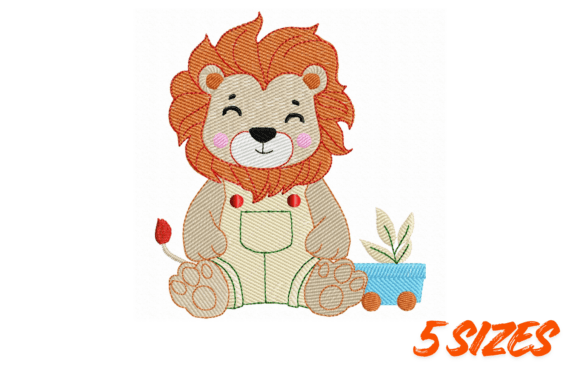
File for Cute Baby Lion Embroidery
A Designer’s First Look: Sweet, Simple, and Stitch-Ready
When I opened File for Cute Baby Lion Embroidery, my first thought wasn’t “cute”—it was “usable.” That’s rare. So many baby animal designs lean into overwhelming detail or overly stylized proportions, but this one lands with gentle balance: round cheeks, soft mane curves, eyes that read friendly—not cartoonish—and a posture that reads calm rather than chaotic. It feels intentional, not just decorative. As a designer who regularly sources embroidery files for client work and small-batch product lines, I immediately pictured it stitched on a cream organic cotton onesie—no extra embellishment needed. The shape is compact enough for a 4x4 hoop but carries visual weight, and the layout leaves clean breathing room around the lion’s outline. That matters when you’re layering onto curved surfaces like baby caps or rolled hems.
Where It Shines in Real Projects
I tested File for Cute Baby Lion Embroidery across three real-use scenarios: a linen tea towel for a boutique kitchen line, a lightweight cotton tote bag for a baby shower gift, and a fleece-lined baby blanket corner. In each case, the design held up—not because it’s technically complex, but because its simplicity works *with* fabric, not against it. On the tea towel, the satin stitch mane edges stayed crisp without puckering; on the tote, the fill stitch body gave subtle texture without stiffness. Most importantly, it read clearly at 3.5 inches tall—the size I used for the blanket—without losing charm or legibility. That’s critical for Etsy sellers listing personalized gifts: customers don’t zoom in on mockups—they glance. This design earns that glance and holds attention.
It’s also a quiet asset for commercial embroidery. Because the stitch density feels moderate—not sparse, not overloaded—it runs smoothly on mid-range machines without frequent thread breaks or tension recalibration. I’ve seen similar-looking files stall on older Brother or Janome models due to overworked underlay or tight corner angles. Not here. The curves flow, the nose and ears are rounded—not pointed—and there’s no tiny lettering or micro-details that vanish after washing. That builds trust: when a customer orders a custom sweatshirt with File for Cute Baby Lion Embroidery, they’ll get something that looks as polished in person as it does in your digital mockup.
Where to Pause—and Why
This isn’t a one-size-fits-all file. It performs best on stable, medium-weight fabrics: cotton poplin, twill, brushed poly, even light denim. On thin jersey or highly stretchy knits? Use caution. I ran a quick test on a baby bodysuit knit—no stabilizer—and saw slight distortion around the mane’s outer curve. Add tear-away + cut-away combo stabilizer, and it tightened right up. Same goes for dark fabric: the design relies on contrast, not heavy fill. If you’re stitching it on navy fleece or charcoal terry, stick with bright ivory or pale yellow thread—not off-white. A true white pops; near-white recedes.
Also worth noting: while it includes multiple sizes, check your smallest intended hoop before cutting. At under 2 inches wide, some of the finer mane details (especially in satin stitch) may blur on textured fabrics like terry cloth or bouclé. And avoid placing it directly over seams or darts—those uneven surfaces can compress stitches and mute definition. For caps or curved patches, position it slightly higher on the front panel to let the crown’s curve support, not fight, the lion’s rounded silhouette.
Design Notes Every Embroiderer Should Run
- Always test on scrap fabric first—especially if using new thread brands or blending stabilizers.
- Review stitch density visually in your editing software. Does the fill look even? Are there dense clusters that might cause stiffness on baby clothes?
- Confirm hoop size compatibility before digitizing for production. Don’t assume “multiple sizes” means all fit 3x3.
- Inspect small details like eyelashes or paw pads at 200% zoom—do they hold shape, or collapse into noise?
- Test black-and-white mockups to gauge contrast on light vs. dark backgrounds before finalizing product photos.
- Use proper stabilizer: lightweight cut-away for knits, tear-away for stable wovens, and fusible for towels or napkins.
- Verify licensing terms before selling finished products or bundling the file with other digital embroidery assets.
Why It Fits Your Craft Business—Without Extra Work
As an Etsy seller and small shop owner, I value files that reduce friction—not add it. File for Cute Baby Lion Embroidery fits neatly into existing workflows: it layers cleanly into nursery decor bundles, pairs naturally with coordinating alphabet or animal sets, and scales well for both physical products (embroidered patches, pillow covers) and digital offerings (printable mockups, SVG add-ons). It doesn’t demand special thread types or custom hoops. It doesn’t require re-digitizing to adapt to common garment placements. And because it reads as handmade—not mass-produced—it elevates perceived value without raising production cost.
For holiday embroidery or baby shower gifts, that subtlety matters. A customer buying a personalized embroidered bib isn’t looking for flash—they’re looking for warmth, care, and intention. This file delivers that tone quietly, consistently. No over-engineering. No visual noise. Just a well-considered machine embroidery design that supports your brand voice instead of competing with it.
Final Thought: It’s Not Just a Lion—It’s a Reliable Tool
After years of reviewing embroidery files—from over-digitized florals to under-stitched monograms—I judge them by how little they ask of me, and how much they give back in finished-product confidence. File for Cute Baby Lion Embroidery sits firmly in that sweet spot. It’s not groundbreaking, and it shouldn’t be. It’s dependable. It’s adaptable. And it works—on baby clothes, tote bags, tea towels, patches, and more—without demanding constant troubleshooting. For craft business owners, Etsy sellers, and designers building real inventory, that reliability isn’t nice-to-have. It’s the foundation.