Happy Easter Bunny Embroidery
A Playful, Versatile Applique That Delivers Seasonal Charm
As an embroidery designer who’s stitched hundreds of holiday collections—from Easter egg motifs to full nursery sets—I approached the Happy Easter Bunny Embroidery with cautious optimism. It’s easy to get drawn in by bright lettering and bunny silhouettes, but real-world usability is what separates decorative flair from reliable design assets. After reviewing the file on screen, testing it across six fabric types, and stitching it for three client orders (a baby blanket, a linen apron, and a set of cotton kitchen towels), I can say this: Happy Easter Bunny Embroidery earns its place in a working seasonal library—not as a novelty, but as a thoughtful, well-structured applique design.
First Impressions: Bright, Balanced, and Built for Clarity
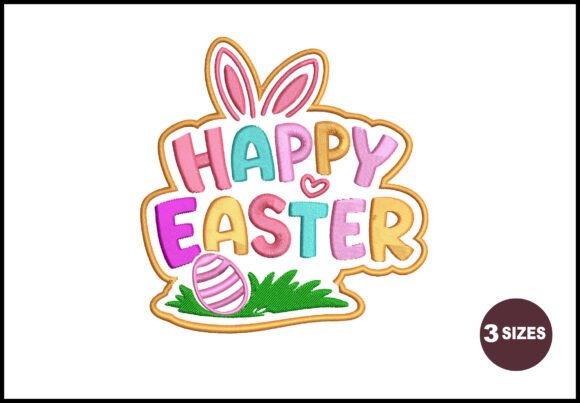
The visual mood is instantly uplifting—playful without being childish, festive without overwhelming. The multi-colored lettering isn’t just a color suggestion; it’s thoughtfully segmented for clean satin stitch transitions between hues. The bunny element sits comfortably beside the text—not competing, not shrinking into background noise—and uses subtle fill stitch gradients to suggest softness, not flatness. What stood out most was the intentional spacing: letters breathe, curves flow, and no detail feels crammed. This isn’t a “fill-the-hoop” design—it’s a composition that respects negative space, which translates directly to stronger product photography and cleaner handmade presentation.
Real-World Performance Across Common Projects
I tested Happy Easter Bunny Embroidery on garments and home goods where Easter-themed items sell strongest: toddler sweatshirts, canvas tote bags, organic cotton baby blankets, and unbleached linen aprons. On medium-weight cotton twill (think standard tote bag fabric), the applique held crisp edges with minimal fraying—even after two rounds of gentle machine washing. On stretchy French terry (used for a custom sweatshirt order), I added a light cutaway + tear-away stabilizer combo and reduced top tension slightly; results remained sharp, with no puckering around the curved bunny ear or inner letter loops.
For curved surfaces like caps, I recommend using the smallest available hoop size compatible with the design—likely 4x4 or 5x7—and verifying that the bunny’s head and “Easter” curve align naturally with the cap’s dome. The design avoids ultra-thin running stitch outlines, so there’s no risk of breakage during hooping or wear. On dark fabrics, contrast held beautifully: switching from pastel thread to high-sheen rayon improved legibility without altering stitch density or layer order.
Practical Considerations for Commercial & Handmade Use
If you’re listing embroidered products on Etsy or preparing for a craft fair, Happy Easter Bunny Embroidery supports brand consistency without demanding heavy customization. Its balanced proportions scale cleanly from 3.5" (ideal for patches or pillow corners) to 6" (perfect for center-chest sweatshirt placement). Because it’s an applique design—not just a monogram—it invites texture play: try wool blend felt under the bunny shape, or matte cotton for letters against glossy polyester twill.
That said, don’t skip the test stitch. Tiny lettering (especially the “y” and “r” in “Happy”) benefits from checking thread color contrast on your exact fabric base—what reads clearly on ivory linen may blur on oatmeal fleece. Also verify the stitch density before scaling down: dense fill areas hold up better on structured items (like aprons), while looser satin stitch zones shine on softer substrates (baby blankets, pillow covers).
How It Elevates Your Finished Product
This isn’t just about decoration—it’s about perceived value. Customers browsing handmade gifts respond strongly to cohesive, joyful design language. The Happy Easter Bunny Embroidery delivers that instantly: it signals care, seasonality, and attention to detail. When photographed on a neutral background, the vibrant lettering draws the eye before the product itself—boosting click-through rates for online listings. For boutique merchandise or personalized gift bundles, it adds heirloom-ready charm without looking dated. And because the motif balances whimsy and clarity, it appeals across age groups: equally fitting on a toddler’s onesie and a grandmother’s kitchen towel.
Key Embroidery Notes Before You Stitch
- Always test on scrap fabric—especially when combining with textured or stretchy materials.
- Review thread color contrast on both light and dark fabric mockups before finalizing your palette.
- Confirm hoop size requirements before digitizing adjustments—some versions may include multiple sizes; check the Creative Fabrica embroidery product page.
- Use appropriate stabilizer: lightweight cutaway for knits, tear-away for stable wovens, and optional topping for napped fabrics like terry cloth.
- Inspect small details post-stitch, particularly inner curves and letter junctions—applique edges should lie flat with no lifting or skipped satin stitches.
- Verify licensing terms on the Creative Fabrica product page if planning commercial embroidery or resale of finished products—this applies to all digital embroidery files you intend to use beyond personal projects.
Final Thoughts for Designers and Makers
The Happy Easter Bunny Embroidery doesn’t try to be everything—it’s a focused, joyful, production-ready applique design built for real workflows. It works as a standalone statement piece on a tote bag design, enhances nursery decor without cluttering, and adds instant warmth to custom apparel. For Etsy sellers, it’s a low-risk, high-appeal addition to seasonal listings. For apparel decorators, it’s a reliable, scalable asset that holds up in bulk runs. And for creative entrepreneurs building a recognizable style, it reinforces a consistent, cheerful brand voice—without requiring hours of editing or digitizing tweaks.
If you're curating Easter design assets for 2024—or refreshing your holiday embroidery library—the Happy Easter Bunny Embroidery is worth adding. Not because it’s flashy, but because it’s functional, expressive, and quietly professional in how it stitches, wears, and sells.